
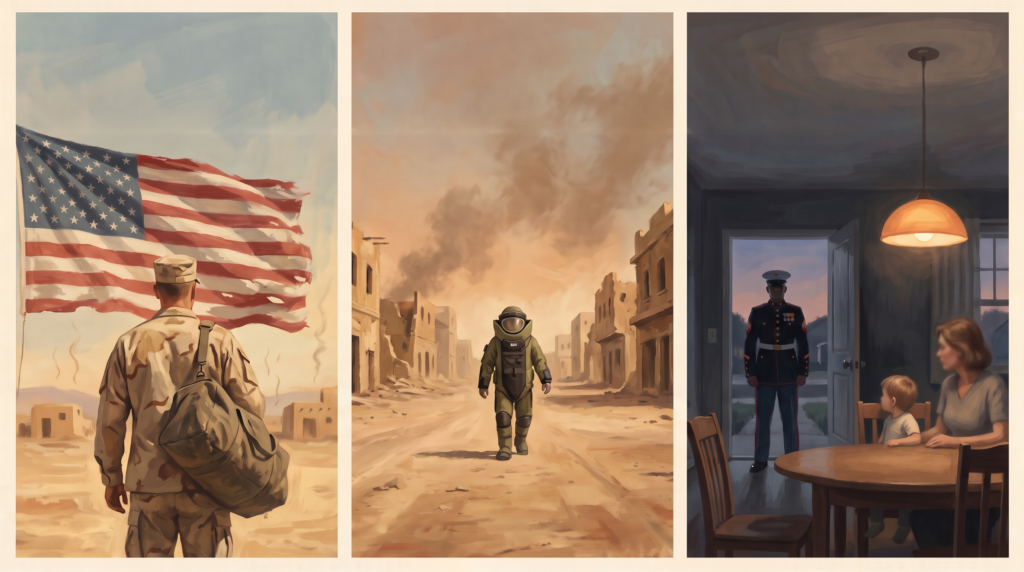
Hollywood has been telling stories about veterans coming home since before “PTSD” existed as a diagnosis. The films span every clinical era — “combat fatigue” in 1949, the unnamed torment of the post-Vietnam wave, the DSM-informed portrayals of the Iraq and Afghanistan years — and every commercial outcome, from the highest-grossing film of 1946 to a run of Iraq War dramas so consistently unprofitable the trade press called the genre box office poison. This is a guide to the films that took veteran mental health seriously, what they got right and wrong according to veterans themselves, and what the box office reveals about which stories audiences were actually willing to sit with.
A note before the history: if you or a veteran you know is in crisis, the Veterans Crisis Line is available 24/7 — dial 988, then press 1 (VA).
The Template: The Best Years of Our Lives (1946)
Every veteran-reintegration film made since 1946 lives in the shadow of William Wyler’s The Best Years of Our Lives. Made for roughly $2.1–3 million, it became the highest-grossing film of 1946 at $23.65 million domestic (Box Office Mojo) and won seven Academy Awards including Best Picture (Wikipedia). Its three WWII veterans struggle with what we would now recognize as PTSD symptoms, alcohol misuse, failing marriages, and employment barriers — subject matter the VA itself still cites as a landmark portrayal of readjustment (VA.gov).
The film’s most radical decision was casting. Harold Russell was a real WWII veteran who lost both hands in a training accident; Wyler cast him after seeing an Army training film, and Russell became the first non-professional actor to win an Oscar — and the only actor ever to win two Oscars for the same role, taking Best Supporting Actor alongside an honorary award “for bringing hope and courage to his fellow veterans” (Wikipedia).
The commercial lesson mattered as much as the artistic one: the single biggest hit of the immediate postwar year was a film about the psychological cost of the war. Audiences did not need the subject softened.
Two companions from the era complete the picture. Twelve O’Clock High (1949) put Gregory Peck through a portrait of “combat fatigue” — the WWII-era term for what is now understood as PTSD — earning $3.2 million in U.S. rentals and two Oscars (Wikipedia). And The Men (1950) gave Marlon Brando his film debut as a paraplegic veteran, shot in a real VA hospital ward with 45 actual paraplegic patients cast alongside the professionals — Brando reportedly lived on the ward for two weeks to prepare (Wikipedia; Emanuel Levy).
The Vietnam Wave: When the Trope Was Born (1976–1990)
The 1970s produced the most influential — and most contested — run of veteran mental health films ever made. Commentary from veteran-run outlets like the Havok Journal argues this is precisely the era when the modern “broken veteran” cliché took shape, citing three films in particular (Havok Journal):
- Taxi Driver (1976): Travis Bickle, the alienated Vietnam veteran whose insomnia curdles into violence, made on a budget of roughly $1.3–1.9 million and grossing $28.3 million domestic (The Numbers).
- Coming Home (1978): Hal Ashby’s VA-hospital drama, a project Jane Fonda helped initiate, pairing a paraplegic veteran’s romance with a returning officer’s psychological collapse. It turned a roughly $3 million budget into $32.7 million domestic and won three Oscars, including both lead acting awards (AFI; Wikipedia).
- The Deer Hunter (1978): Best Picture winner, roughly $49 million domestic on an estimated $15 million budget (Wikipedia). It is also the era’s cautionary tale about accuracy: the central Russian-roulette device has no documented historical basis — it was lifted from an unrelated screenplay — and drew organized protests from Vietnam Veterans Against the War, with 13 arrested outside the ceremony on Oscar night. War correspondent Peter Arnett called the device “a bloody lie” (SlashFilm).
The era’s most commercially instructive film, though, is the one remembered as an action franchise. First Blood (1982) grossed $125.2 million worldwide on a $14–15 million budget (Box Office Mojo) — and its entire climax is a PTSD confession. The original ending killed Rambo off, as the novel had; test audiences rejected it, and the reshot finale replaced the death with the “I can’t turn it off!” breakdown monologue, reportedly rewritten by Stallone himself (ScreenRant). Novelist David Morrell developed the premise partly from conversations with Vietnam veteran students in his writing class who disclosed their own trauma (Clio’s Psyche). The most famous action hero of the 1980s was introduced to audiences as a homeless veteran in psychiatric crisis — a fact the sequels spent a decade burying.
The wave closed with Oliver Stone’s Born on the Fourth of July (1989), which turned Ron Kovic’s memoir into $161 million worldwide on a $14–17.8 million budget and won Stone the Directing Oscar (The Numbers), and Adrian Lyne’s Jacob’s Ladder (1990), which processed veteran trauma through horror imagery and contested allegations of hallucinogen testing on soldiers (Wikipedia). And one supporting performance arguably did more for public perception than either: Gary Sinise’s Lt. Dan in Forrest Gump (1994) — survivor’s guilt, alcoholism, and eventually recovery — earned Sinise the Disabled American Veterans’ National Commander’s Award for its “honest portrayal of a catastrophically injured veteran” (LA Times).
The Iraq War Curse: Prestige Without an Audience (2005–2013)
Here is where the box office data tells a story no other lens can. Between roughly 2005 and 2013, at least 23 Iraq War-themed features were released — and virtually all of them lost money, so consistently that scholars titled a book on the cycle A Toxic Genre (Perlego). The veteran mental health entries were no exception:
| Film | Budget | Domestic gross | Outcome |
|---|---|---|---|
| In the Valley of Elah (2007) | $22–23M | $6.8M | Bomb (Wikipedia) |
| Stop-Loss (2008) | $25M | $10.9M | Bomb (Wikipedia) |
| The Hurt Locker (2009) | $15M | $17M | Lowest-grossing Best Picture winner ever (Guinness) |
| Brothers (2009) | $26M | $28.5M | Broke roughly even (Wikipedia) |
The Hurt Locker deserves its own paragraph, because it captures a tension this genre never resolves. Kathryn Bigelow’s film won six Oscars, including Best Picture and the first Best Director win for a woman — and grossed just $17 million domestic against a $15 million budget, the worst box office of any Best Picture winner on record (Collider). Meanwhile, veterans were its harshest critics: IAVA executive director Paul Rieckhoff, himself an Iraq veteran, called its bomb-disposal depiction “disrespectful” (NPR), and in a 2020 U.S. Army War College survey it was the single most frequently named “inaccurate” combat film, cited by 25% of respondents who named a title (Parameters). Critical acclaim, commercial success, and credibility with the people depicted turned out to be three entirely independent variables.
Industry analysis of the losing streak points to audience fatigue with an ongoing, unresolved war and the fact that most entries were built as prestige dramas rather than mainstream entertainment (The Guardian).
The Outlier: American Sniper (2014)
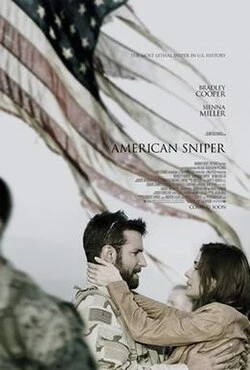
Then Clint Eastwood broke the curse by an order of magnitude. American Sniper (2014) grossed $547.7 million worldwide on a roughly $59 million budget — the highest-grossing war film ever made and the top domestic release of 2014 (Box Office Mojo; LA Times). Trade analysis credits the difference to a bankable director-star pairing, a real-life hero narrative centered on an individual rather than a policy critique, and marketing built around biography rather than the war itself (The Guardian).
The mental health story surrounding the film is darker than anything in it. Chris Kyle was killed in 2013 by Eddie Ray Routh, a fellow Iraq War veteran with PTSD whom Kyle had taken to a gun range as an act of peer support (Wikipedia). Kyle himself was never formally diagnosed, but his documented hypervigilance, insomnia, and VA disability record closely track the clinical criteria, and he privately told Routh he had struggled too (Salon). Notably, the same Army War College survey that panned The Hurt Locker rated American Sniper meaningfully more accurate than the Hollywood combat-film average — 4.7 out of 6 versus a 4.0 mean (Parameters).
And in a juxtaposition Military Times highlighted at the time: the same season American Sniper crossed $428 million domestic, the Oscar for Best Documentary Short went to Crisis Hotline: Veterans Press 1 (2013), HBO’s film about the VA’s crisis line responders in Canandaigua, New York (Military Times). Hollywood’s biggest war blockbuster and its most direct film about veteran suicide prevention shared an awards stage — and only one of them had a marketing budget.
The Quiet Era: Streaming, Small Films, Honest Portraits (2017–Present)
Post-Sniper, the theatrical market for these stories stayed brutal. Thank You for Your Service (2016), adapted from David Finkel’s rigorously reported book, grossed under $10 million on a $20 million budget (Wikipedia). Megan Leavey (2017) managed $14.5 million worldwide (Wikipedia). The Outpost (2020) had the misfortune of a mid-pandemic release and grossed under $200,000 domestic (The Numbers).
But this era also produced some of the most clinically honest portraits in the genre’s history, mostly at small scale:
- Leave No Trace (2018): Debra Granik’s drama about a veteran with PTSD living off-grid with his daughter grossed just $7.7 million worldwide — while becoming the most-reviewed film ever to hold a 100% Certified Fresh Rotten Tomatoes score at the time, with 253 reviews (Men’s Journal).
- Restrepo (2010) and its companion Korengal (2014), Sebastian Junger’s embedded documentaries, grossed $1.4 million and $101,000 respectively (Wikipedia) — commercially negligible, but foundational documents of what deployment actually does to a platoon.
- The economics finally shifted when streamers stepped in. Apple paid in the mid-$40 million range for Cherry (2021), Tom Holland’s turn as a medic spiraling through PTSD and opioid addiction (TheWrap), and released Causeway (2022), with Jennifer Lawrence as a soldier rebuilding after a traumatic brain injury (Apple). For stories the theatrical market punished for two decades, streaming’s flat-fee model quietly became the only reliable buyer.
Causeway’s focus on TBI reflects the clinical reality of the post-9/11 wars: the Department of Defense diagnosed over 430,000 traumatic brain injuries among service members between 2000 and 2020, and brain injuries account for an estimated 22% of Iraq/Afghanistan combat casualties, versus roughly 12% in Vietnam (Swords to Plowshares).
What the Films Get Wrong: The Data on the “Broken Veteran”
For a veterans organization evaluating these films, the numbers behind the portrayals matter as much as the portrayals themselves.
The clinical reality: according to the VA’s National Center for PTSD, lifetime PTSD prevalence runs about 3% for WWII/Korea veterans, 10% for Vietnam veterans (an older major study, the NVVRS, put the lifetime figure near 31%), 21% for Gulf War veterans, and 29% for Iraq/Afghanistan veterans (VA.gov; VA epidemiology). RAND’s landmark Invisible Wounds of War study estimated roughly 300,000 of 1.64 million post-9/11 deployed service members were living with PTSD or major depression — and that only 53% of them had sought care in the prior year (RAND). The VA’s most recent suicide prevention report counted 6,398 veteran suicide deaths in 2023 — an average of 17.5 per day, down from the 2018 peak of 18.5 (VA).
The screen reality: a USC Annenberg study of the top 100 films of 2016 found only 1.7% of speaking characters were depicted with any significant mental health condition — against roughly 20% of U.S. adults who live with one — and PTSD or anxiety appeared in just 0.3% of characters (USC Annenberg). When veteran characters do appear, the portrayal skews toward crisis: a peer-reviewed study of treatment-seeking Iraq/Afghanistan veterans found the most common perceived public stereotypes were “dangerous/violent” and “crazy” — stigma the veterans themselves linked directly to media portrayals (PubMed). Experimental research confirms the mechanism: even brief exposure to stereotypical veteran coverage measurably shifts audience attitudes (SAGE Journals). Organizations like CNAS argue the resulting “simultaneously heroes and broken individuals” framing widens the civil-military divide (CNAS), and veteran-focused groups contend it creates real barriers to treatment and employment (Victory Bridge).
The Bottom Line
Eighty years of data points to an uncomfortable conclusion: the market has never consistently rewarded honesty about veteran mental health. The Best Years of Our Lives proved in 1946 that it could be the biggest film of the year; the Iraq War cycle proved that two decades of prestige treatments could lose money almost without exception; American Sniper proved a veteran’s story could gross half a billion dollars when packaged as individual heroism. The films veterans and clinicians tend to rate most honest — Leave No Trace, Restrepo, Causeway — earned the least. That is not a reason to stop making them. It is the strongest argument for why the streaming era, which pays for these stories upfront rather than betting on opening weekends, may quietly be the best thing that has happened to this genre since Harold Russell won two Oscars for a single role.
If you or a veteran you know needs support, the Veterans Crisis Line is available 24/7: dial 988, then press 1, or text 838255 (VA).
Sources
- Box Office Mojo — The Best Years of Our Lives: https://www.boxofficemojo.com/title/tt0036868/
- VA.gov — The Best Years of Our Lives history: https://department.va.gov/history/best-years/
- Wikipedia — The Best Years of Our Lives: https://en.wikipedia.org/wiki/The_Best_Years_of_Our_Lives
- Wikipedia — Harold Russell: https://en.wikipedia.org/wiki/Harold_Russell
- Wikipedia — Twelve O’Clock High: https://en.wikipedia.org/wiki/Twelve_O%27Clock_High
- Wikipedia — The Men (1950): https://en.wikipedia.org/wiki/The_Men_(1950_film)
- Emanuel Levy — The Men review: https://emanuellevy.com/review/men-the-1950-8/
- The Numbers — Taxi Driver: https://www.the-numbers.com/movie/Taxi-Driver
- AFI Catalog Spotlight — Coming Home: https://www.afi.com/news/coming-home-1978-afi-catalog-spotlight/
- Wikipedia — Coming Home: https://en.wikipedia.org/wiki/Coming_Home_(1978_film)
- Wikipedia — The Deer Hunter: https://en.wikipedia.org/wiki/The_Deer_Hunter
- SlashFilm — The Deer Hunter controversy: https://www.slashfilm.com/705761/the-deer-hunter-controversy-explained-the-horror-of-russian-roulette/
- Box Office Mojo — First Blood: https://www.boxofficemojo.com/title/tt0083944/
- ScreenRant — First Blood ending change: https://screenrant.com/first-blood-movie-ending-rambo-death-change-reason/
- Clio’s Psyche — Trauma and justice in First Blood: https://cliospsyche.org/articles/wegner-b-2021-trauma-tragedy-recovery-and-justice-in-rambo-first-blood-clios-psyche-273-388-394
- The Numbers — Born on the Fourth of July: https://www.the-numbers.com/movie/Born-on-the-Fourth-of-July-(1989)
- Wikipedia — Jacob’s Ladder: https://en.wikipedia.org/wiki/Jacob%27s_Ladder_(1990_film)
- LA Times — Gary Sinise DAV award: https://www.latimes.com/archives/la-xpm-1994-07-10-ca-14048-story.html
- Perlego — A Toxic Genre: The Iraq War Films: https://www.perlego.com/book/665253/a-toxic-genre-the-iraq-war-films-pdf
- Wikipedia — In the Valley of Elah: https://en.wikipedia.org/wiki/In_the_Valley_of_Elah
- Wikipedia — Stop-Loss: https://en.wikipedia.org/wiki/Stop-Loss_(film)
- Guinness World Records — Lowest-grossing Best Picture winner: https://www.guinnessworldrecords.com/world-records/93595-lowest-grossing-best-picture-oscar-winner
- Collider — The Hurt Locker box office: https://collider.com/the-hurt-locker-best-picture-flop/
- NPR — Veterans on The Hurt Locker: https://www.npr.org/2010/03/05/124319820/veterans-say-exaggerations-abound-in-hurt-locker
- U.S. Army War College, Parameters — combat film accuracy survey: https://press.armywarcollege.edu/cgi/viewcontent.cgi?article=2874&context=parameters
- Wikipedia — Brothers (2009): https://en.wikipedia.org/wiki/Brothers_(2009_film)
- The Guardian — Why American Sniper fought an uphill battle: https://www.theguardian.com/film/2015/jan/13/why-american-sniper-is-fighting-an-uphill-battle-in-hollywood
- Box Office Mojo — American Sniper: https://www.boxofficemojo.com/title/tt2179136/
- LA Times — American Sniper worldwide records: https://www.latimes.com/entertainment/envelope/cotown/la-et-ct-american-sniper-worldwide-2014-records-20150308-story.html
- The Guardian — Hollywood and the Iraq War: https://www.theguardian.com/film/2023/mar/16/hollywood-iraq-war-hurt-locker-american-sniper
- Wikipedia — Murders of Chris Kyle and Chad Littlefield: https://en.wikipedia.org/wiki/Murders_of_Chris_Kyle_and_Chad_Littlefield
- Salon — Chris Kyle’s PTSD: https://www.salon.com/2015/02/19/chris_kyles_ptsd_the_untold_real_life_american_sniper_story/
- Military Times — Crisis Hotline Oscar win: https://www.militarytimes.com/veterans/2015/02/23/va-suicide-hotline-film-wins-oscar/
- Wikipedia — Thank You for Your Service (2017): https://en.wikipedia.org/wiki/Thank_You_for_Your_Service_(2017_film)
- Wikipedia — Megan Leavey: https://en.wikipedia.org/wiki/Megan_Leavey_(film)
- The Numbers — The Outpost: https://www.the-numbers.com/movie/Outpost-The
- Men’s Journal — Leave No Trace Rotten Tomatoes record: https://www.mensjournal.com/entertainment/leave-no-trace-perfect-rotten-tomatoes-score
- Wikipedia — Restrepo: https://en.wikipedia.org/wiki/Restrepo_(film)
- TheWrap — Apple’s Cherry deal: https://www.thewrap.com/apple-tom-holland-heist-film-cherry-russo-brothers-mid-40-million/
- Apple — Causeway press release: https://www.apple.com/tv-pr/news/2022/07/apple-original-films-lands-causeway-new-feature-starring-and-produced-by-academy-award-winner-jennifer-lawrence/
- Swords to Plowshares — TBI overview: https://www.swords-to-plowshares.org/toolbox-article/traumatic-brain-injury
- VA National Center for PTSD — How common is PTSD in veterans: https://www.ptsd.va.gov/understand/common/common_veterans.asp
- VA — PTSD epidemiology: https://www.ptsd.va.gov/professional/treat/essentials/epidemiology.asp
- RAND — Invisible Wounds of War research brief: https://www.rand.org/pubs/research_briefs/RB9336.html
- VA — Suicide prevention data (2025 annual report): https://www.mentalhealth.va.gov/suicide_prevention/data.asp
- USC Annenberg Inclusion Initiative — Mental health in film (PDF): https://assets.uscannenberg.org/docs/aii-study-mental-health-media_052019.pdf
- PubMed — Veteran PTSD stigma study: https://pubmed.ncbi.nlm.nih.gov/23750758/
- SAGE Journals — Media stereotyping of veterans experiment: https://journals.sagepub.com/doi/10.1177/0095327X20986145
- CNAS — Media’s narrow portrayal of service members: https://www.cnas.org/publications/commentary/how-the-medias-narrow-portrayal-of-service-members-does-the-military-a-disservice
- Victory Bridge — The PTSD myth and media narratives: https://www.victorybridge.org/post/the-ptsd-myth-how-media-narratives-create-barriers-for-those-who-serve
- Havok Journal — Rejecting the myth of the broken veteran: https://havokjournal.com/culture/rejecting-the-myth-of-the-broken-veteran/